Startup instrumentation
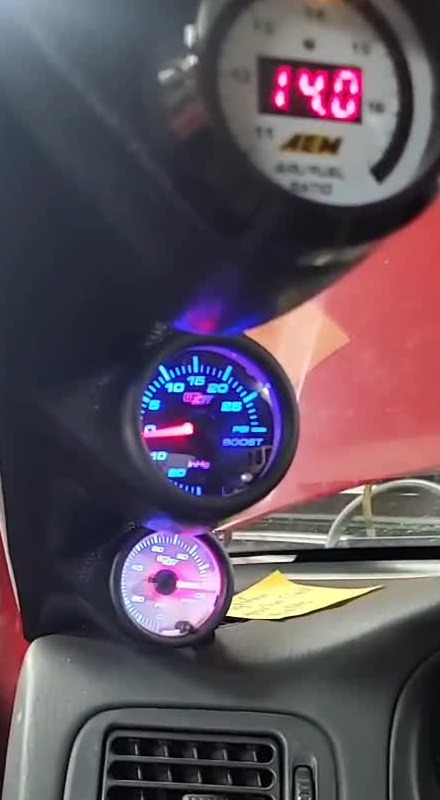
AEM wideband, boost/vacuum gauge, and oil-pressure gauge in the car during the first-start stage.
Not just the finished spec list—the decisions, corrections, first-start proof, tuning checkpoints, and future milestones that turn the Civic into a documented build.
The engine concept centers on an F23 bottom end for displacement and torque, paired with H-series head architecture and a turbo sized with room beyond the initial low-boost stage.
An earlier result used the wrong block/crank inputs and produced a false piston-to-deck number. Correcting the calculator to the F23/F23 combination brought piston-to-deck back near zero and the estimated static compression to 10.37:1.
The current system is intentionally straightforward and has more turbo than the first 5 PSI stage needs. The extra capacity leaves room for later engine and fuel upgrades.
The build moved from parts list to running car. The AEM wideband was active, the boost/vacuum gauge was installed, and cold-start oil pressure was observed around 90–95 PSI.
The immediate mission is hot oil-pressure verification, fuel-pressure confirmation, base timing sync, wideband validation, leak checks, and clean logged pulls on wastegate/low boost.
Once the base setup is stable, the project can focus on controlled boost delivery, high-speed pull data, traction at speed, and drivetrain changes that make power useful from a roll.
The current site preserves early proof instead of waiting for the polished final version. This is the stage where oil pressure, AFR behavior, base timing, and real logs matter more than a headline horsepower number.
AEM wideband, boost/vacuum gauge, and oil-pressure gauge in the car during the first-start stage.
Verify hot oil pressure. Confirm fuel pressure rises correctly. Sync true crank timing to eCtune commanded timing. Validate the wideband. Log AFR, MAP, RPM, IAT, coolant, voltage, and timing. Read plugs. Inspect every leak path.